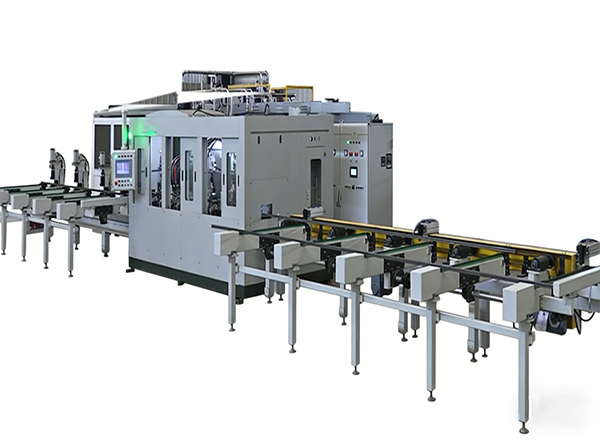
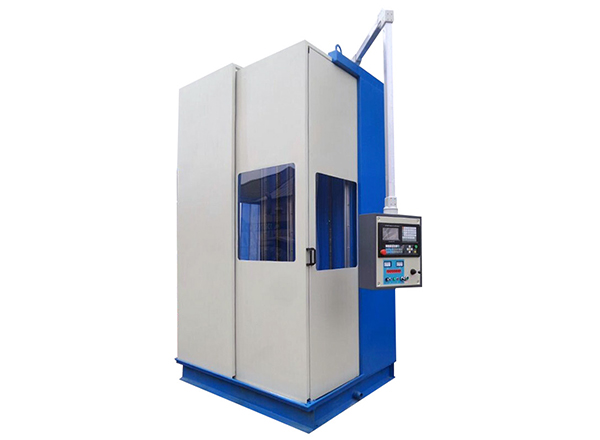
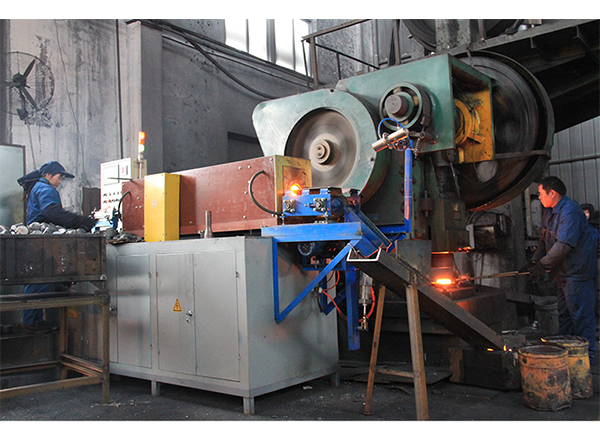
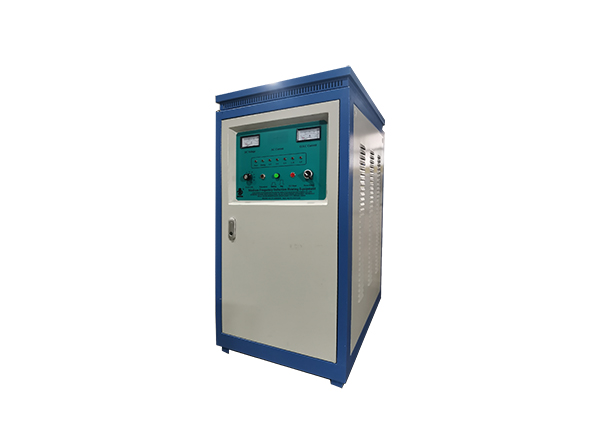
This production line offers the flexibility to address the screw heat treatment requirements of critical applications—such as industrial robot RV reducers, semiconductor EUV lithography machines, and electric drive suspension systems for new energy vehicles. It is capable of both high-volume standardized production and the processing of custom-specified workpieces. By facilitating the localization of core technologies, the system helps enterprises reduce capital investment and operational costs while enhancing the core competitiveness of their products. Furthermore, it contributes to increasing the domestic content ratio of transmission components in high-end equipment, thereby providing robust support for the advancement of intelligent manufacturing.

Utilizing a dual-control system comprising a PLC and a DSP+CPLD, the equipment integrates modules for real-time temperature field monitoring and closed-loop regulation of cooling medium parameters, enabling dynamic adaptation to ball screws of varying specifications—ranging from 20 to 140 mm in diameter and 500 to 10,000 mm in length.
Through a structural design featuring a three-jaw chuck and an adaptive tailstock center, the system effectively suppresses workpiece elongation and deformation during the heating process. This keeps radial distortion within the lower limits of industry standards, thereby significantly reducing the demands placed on subsequent straightening operations. All process parameters are fully traceable and reproducible, marking a transformative upgrade from "post-process inspection" to "controllable process execution."
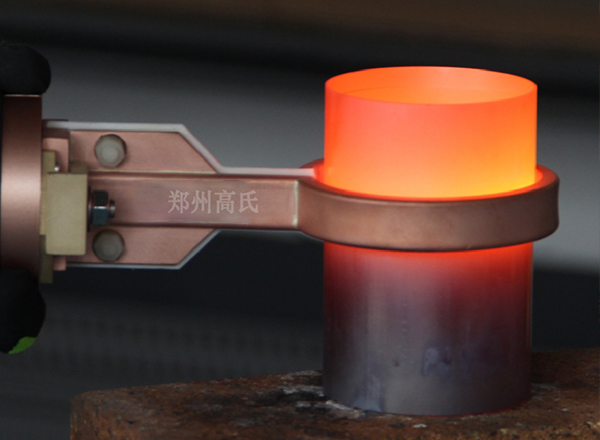
Employing a synergistic process of 500 Hz preheating and 2000 Hz precision heating—coupled with custom-designed contour-following induction coils—the system enables precise control over the effective case depth. This fulfills differentiated hardening requirements of 5–8 mm at the thread crests and 3–4 mm at the thread roots, while limiting the temperature differential between the crests and roots to within 26°C. Compared to traditional single-frequency heating technologies, this approach improves case depth uniformity by 35%, significantly mitigating the risks of raceway spalling and micropitting. Consequently, the fatigue life of the ball screws is extended by over 40%, fully satisfying mechanical performance criteria with a tensile strength of ≥900 MPa and a yield strength of ≥700 MPa.
The production line features a design with complete separation of water and electricity within a fully enclosed cabinet. It is equipped with a hybrid cooling system combining forced water cooling and air conditioning, achieving a power conversion efficiency exceeding 97%—representing a 30% to 50% energy savings compared to traditional SCR-based equipment.
Fluctuations in the quenching medium concentration are controlled within ±1%, while pressure accuracy reaches ±0.05 MPa. Coupled with zero-emission vacuum cleaning technology, the solvent recovery rate exceeds 98%, fully complying with new environmental protection and emission reduction regulations. Through waste heat recovery and an intelligent start-stop design, overall energy consumption is further reduced, thereby assisting enterprises in transitioning toward green manufacturing.
Strict adherence to a three-tier inspection standard is maintained. At the raw material stage, checks are conducted on macrostructure, grain size, and non-metallic inclusion levels to ensure an oxygen content of ≤3 ppm, a grain size of ≥Grade 5, and a banding structure of ≤Grade 2.
During the process stage, quenching temperature, holding time, and cooling rate are monitored in real-time; process parameters are dynamically optimized based on CCT curves and hardness distribution profiles.